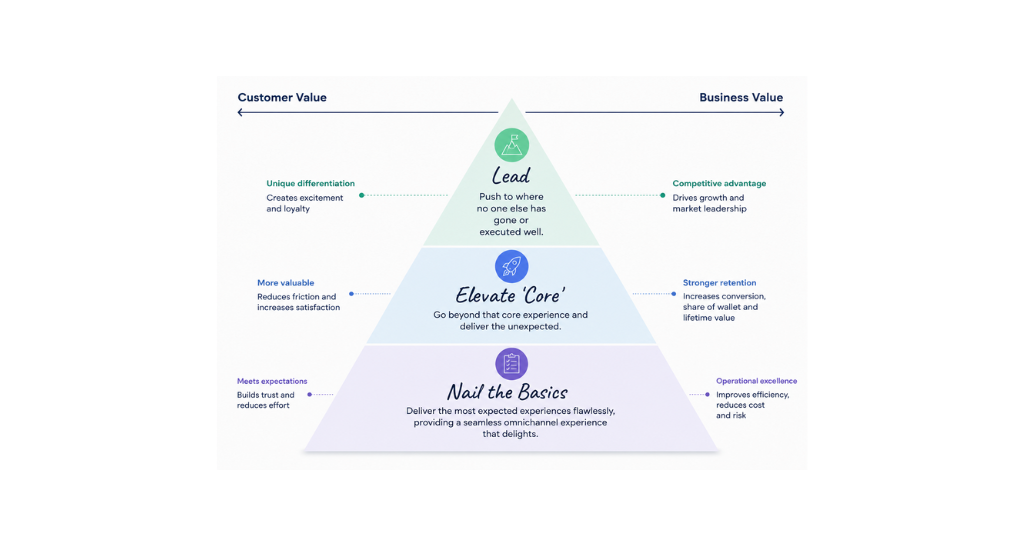
The Customer Experience Pyramid is a customer experience framework I’ve used to help product teams prioritise investments across customer journeys. It provides a practical approach to balancing customer value and business value while deciding whether to focus on fixing fundamentals, improving core experiences, or creating market-leading innovation.
One of the most common mistakes I see product teams make is assuming that innovation automatically creates great customer experiences. It doesn’t.
Customers rarely care whether something is innovative. They care whether it helps them achieve what they’re trying to do.
Over the years, I’ve found that the most successful products balance three things:
- Delivering what customers expect
- Improving what customers value
- Creating experiences competitors can’t easily replicate
To help teams think about this balance, I developed the Customer Experience Pyramid, a simple framework for evaluating where to invest across a product or customer journey.
At its heart, the framework recognises that great customer experiences are built on a foundation of customer value and business value working together.
The Customer Experience Pyramid
The pyramid consists of three layers:
- Nail the Basics: Deliver the experiences customers expect flawlessly.
- Elevate the Core: Improve the core experience by removing friction and creating additional value.
- Lead: Create experiences that competitors haven’t delivered, or haven’t executed well.
The important thing to understand is that this isn’t a sequential maturity model.
You don’t complete one layer before moving to the next.
The strongest products and organisations have investments across all three layers at the same time.
More importantly, what sits at the top of the pyramid today eventually becomes part of the foundation tomorrow.
Customer expectations never stand still.
Neither should product teams.
The Missing Dimension: Customer Value and Business Value
What makes this framework different from many traditional customer experience models is that it isn’t purely focused on customers.
Every product investment should be evaluated through two lenses:
What value does this create for customers?
and
What value does this create for the business?
The most effective product investments create both.
Customer value and business value shouldn’t be viewed as competing priorities.
In the best products, they reinforce each other.
When customers can achieve their goals more easily, businesses typically see improved conversion, retention, engagement, and profitability.
The role of product teams is to identify opportunities where customer value and business value align.
One of the most overlooked drivers of customer value is cognitive effort.
Every additional decision, piece of information, or moment of uncertainty increases the mental load placed on customers.
Behavioural psychologist Daniel Kahneman described this through two modes of thinking in his book Thinking, Fast and Slow:
System 1 is fast, intuitive, and effortless.
System 2 is slower, deliberate, and cognitively demanding.
Most customers want to operate in System 1.
They want products and experiences that feel obvious, familiar, and easy to navigate.
The role of great product design is often not to add more functionality, but to remove unnecessary thinking.
Reducing cognitive load benefits customers through simplicity and confidence, while benefiting businesses through improved conversion, engagement, and retention.
Layer One: Nail the Basics, The Foundation of Great Customer Experience
This is the foundation of the pyramid.
These are the experiences customers expect to work every single time.
When they work well, customers rarely notice.
When they fail, customers remember.
In retail, examples include:
- Finding products through search and navigation
- Selecting a size and colour
- Adding products to basket
- Completing checkout
- Receiving delivery updates
- Processing returns
These experiences aren’t exciting.
They aren’t innovative.
But they are essential.
A customer being able to select their size and complete a purchase is a basic expectation.
The customer value is obvious: they can complete their purchase.
The business value is equally clear: conversion and revenue.
The strongest foundational experiences minimise the amount of thinking customers need to do.
Customers shouldn’t have to work out where to click, interpret unclear language, or second-guess what happens next.
Good basics allow customers to operate almost entirely in System 1 thinking, moving quickly and confidently through a journey with minimal effort.
This is why seemingly simple improvements such as clearer navigation, fewer form fields, better search results, or a streamlined checkout often deliver disproportionate value.
They’re not just removing friction.
They’re reducing cognitive load.
Many organisations chase innovation before they’ve solved the biggest sources of customer frustration.
That’s often a mistake.
Layer Two: Elevate the Core, Reducing Friction and Customer Effort
Once the basics are working consistently, the opportunity becomes making the experience smarter, easier, and more valuable.
This layer focuses on reducing friction and improving confidence.
If the goal of the foundational layer is reducing friction, the goal of the elevated layer is reducing decisions.
The best elevated experiences help customers make better choices without requiring additional effort.
Using the same retail example:
A customer manually comparing size charts across multiple brands is operating in System 2, analysing information and making conscious decisions.
An elevated experience might include:
- AI-powered size recommendations
- Fit guidance based on previous purchases
- Brand-specific sizing intelligence
- Recommendations informed by returns history
These capabilities shift much of that effort back into System 1 by providing confidence and reducing uncertainty.
The customer spends less time thinking and more time progressing towards their goal.
The customer value is increased confidence that they’re buying the right product.
The business value is improved conversion, fewer returns, and increased profitability.
This is often where product teams uncover some of the highest-value opportunities because customer outcomes and commercial outcomes are strongly aligned.
Layer Three: Lead by Creating Competitive Advantage Through Customer Experience
The top of the pyramid is where differentiation lives.
These are experiences that competitors haven’t delivered, or haven’t delivered particularly well.
Examples might include:
- Virtual fitting rooms
- Body scanning technology
- Digital measurement profiles
- Augmented reality product visualisation
The objective isn’t innovation for innovation’s sake.
The objective is solving customer problems in ways that weren’t previously possible.
For customers, these experiences can create confidence, convenience, and delight.
For businesses, they can create differentiation, loyalty, market leadership, and sustainable competitive advantage.
The strongest innovations don’t increase complexity.
They remove it.
The most successful leading experiences make sophisticated technology feel invisible to the customer.
A customer doesn’t care about the algorithm, machine learning model, or body scanning technology behind the scenes.
They care that choosing the right product suddenly feels effortless.
That’s the real measure of innovation.
However, innovation has a shelf life.
Today’s leading experience becomes tomorrow’s elevated experience.
Eventually, it becomes table stakes.
Why the Pyramid Is Dynamic
One of the most important principles of the framework is that every layer shifts over time.
Twenty years ago, online ordering was innovative.
Today, it’s expected.
A decade ago, mobile apps were a differentiator.
Today, customers assume they’ll exist.
More recently, one-click checkout was considered leading.
Increasingly, customers expect it as part of the standard experience.
This means the journey to the top of the pyramid never ends.
As competitors catch up and customer expectations evolve, organisations must continually reassess where their experiences sit.
What was once leading eventually becomes the new basic.
How I Use the Framework
Whenever I’m evaluating a roadmap, customer journey, or investment opportunity, I ask three questions:
Are we fixing a basic?
Will this remove friction from an experience customers already expect?
Are we elevating the core?
Will this improve a journey customers already value?
Are we leading?
Will this create meaningful differentiation that competitors will struggle to replicate?
The strongest product portfolios balance investments across all three.
Too much focus on basics creates parity.
Too much focus on innovation creates fragility.
The most successful organisations do both.
Applying the Framework to Loyalty
Much of my recent work has focused on loyalty, and the framework applies equally well here.
Nail the Basics
- Easy sign-up
- Clear programme benefits
- Visible points balance
- Simple reward redemption
Elevate the Core
- Personalised offers
- Dynamic rewards
- Contextual recommendations
- Tailored communications
Lead
- AI-generated rewards
- Predictive loyalty experiences
- Real-time personalisation
- Autonomous loyalty assistants
The principle remains the same.
Deliver what customers expect.
Improve what they value.
Then create what they never expected.
Final Thoughts
Innovation doesn’t create great customer experiences.
Great customer experiences don’t happen when customers think more.
They happen when customers can achieve their goals with less effort, less uncertainty, and greater confidence.
The Customer Experience Pyramid helps teams identify where to remove friction, reduce cognitive load, and create value for both customers and the business.
Because the best experiences don’t just delight customers.
They make the right thing feel effortless.
The challenge isn’t deciding whether to focus on basics, core experiences, or innovation.
The challenge is knowing when to invest in each.
That’s where the Customer Experience Pyramid helps.