The Challenge
Waitrose has long benefited from strong brand affinity, yet customer insight highlighted a clear limitation in the My Waitrose programme. While it delivered tangible, transactional benefits, customers struggled to see its value when compared with more overtly reward-led grocery loyalty schemes in the market. The proposition worked, but it rarely felt rewarding.
In a landscape where loyalty programmes increasingly compete on visible, immediate incentives, My Waitrose risked being perceived as functional rather than emotionally engaging. The question was not how to out-compete on discounts, but how to create a deeper sense of appreciation.
The challenge from leadership was clear: how do we move My Waitrose beyond a purely transactional exchange and create something that genuinely makes customers feel valued, without adding friction or asking them to shop differently?
We knew this wasn’t going to be a quick fix. Any meaningful impact would take time, potentially six to twelve months or more. But what was clear was that standing still wasn’t an option. We needed to act, and we needed to invest properly, giving the idea the time, care and space it needed to succeed.
Starting with a Design Sprint, Not a Solution
Instead of jumping straight into building something, we took a step back and ran a design sprint. The aim wasn’t to land on a single “right” answer straight away, but to explore different ways loyalty could work and see what genuinely resonated with customers.
We tried a number of ideas, from challenges and missions to more personalised incentives. One concept stood out almost immediately: spend thresholds. Customers just got it. Shop as you normally would, and you get something back.
That simplicity was the key. It felt fair, easy to understand and true to the Waitrose brand. We shared what we’d learned, along with early concepts and customer feedback, with the leadership team. With clear alignment on the opportunity, we were given the green light to go deeper and move into discovery.
Discovery: Turning a Strong Idea into a Deliverable Proposition
We ran a four-week discovery to answer a critical question: could a threshold-based rewards model work for Waitrose from a customer, commercial and operational perspective?
Discovery focused on four parallel tracks:
- Customer experience: refining and testing app and web designs with customers to ensure they were intuitive, simple and clear to understand and navigate.
- Commercial viability: working closely with Finance and Insight to model reward cost against incremental value.
- Technical feasibility: assessing how thresholds could be delivered using existing capabilities and how we may scale in the future.
- Operational readiness: understanding the impact across stores, customer care and communications.
By the end of discovery, we had validated designs ready to build, a flexible commercial model to tune thresholds responsibly, a clear technical approach that avoided unnecessary complexity, and alignment on a phased pilot rather than a high-risk big bang launch.
Most importantly, discovery created confidence. This was not just a good idea, it was a deliverable one.
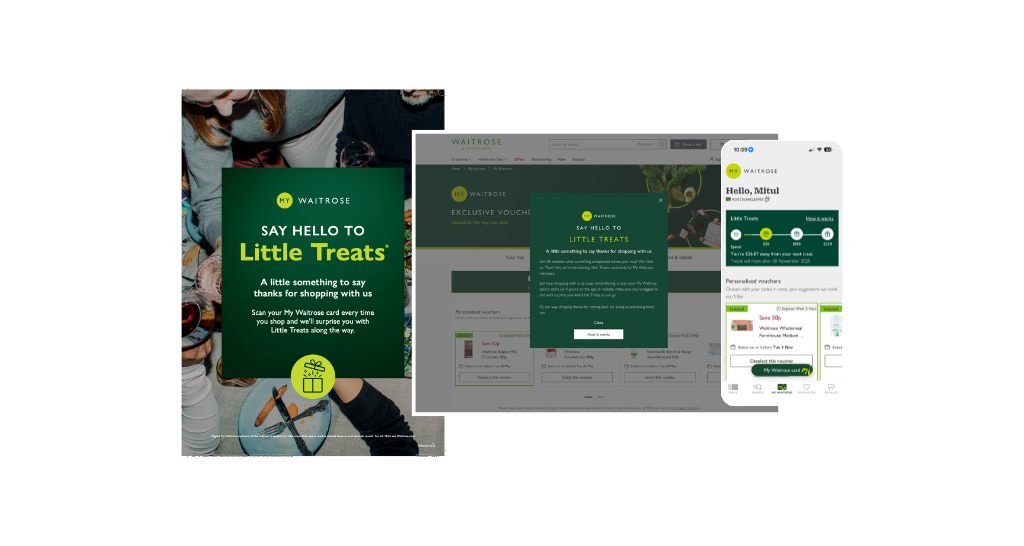
Introducing Little Treats
Out of discovery came Little Treats.
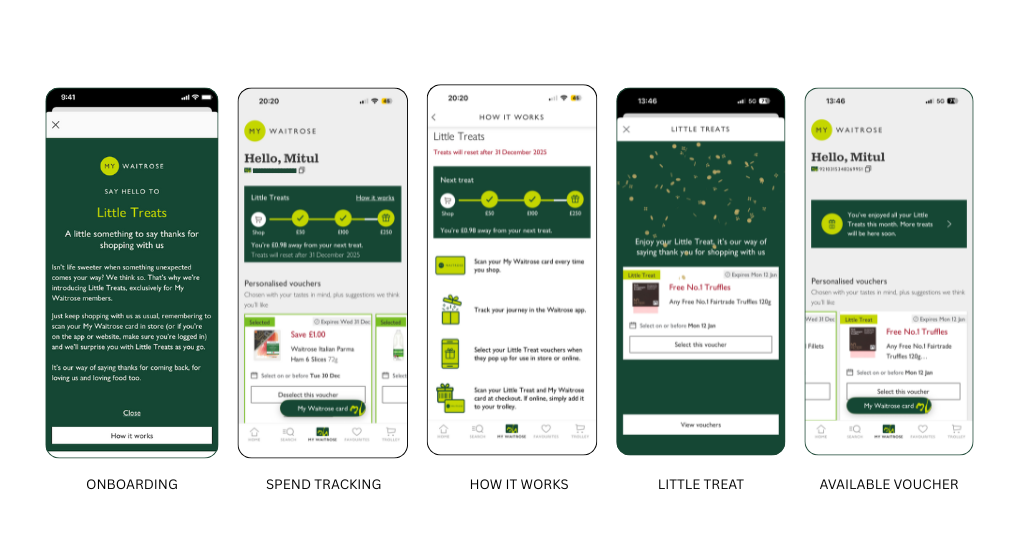
The proposition was deliberately designed to feel achievable, effortless and genuinely rewarding. Customers are thanked for everyday shopping, not exceptional behaviour. There are no challenges to complete and no rules to remember.
Each month, customers track their spend and unlock Little Treats at £50, £100 and £250, simply by scanning their My Waitrose card. Rewards appear automatically in the app, ready to redeem on a future shop.
No behaviour change required. Just a clearer, more motivating value exchange.
Pilot, Learn, Then Scale with Confidence
Little Treats first launched through a regional pilot. This allowed us to test technical robustness, ensure operational readiness across stores, monitor customer understanding and sentiment, and protect core loyalty metrics with clear guardrails.
The pilot performed strongly and, crucially, did not negatively impact any key metrics. That gave us the confidence to move into a phased national rollout, culminating in a full launch in November just before Christmas trade.
The launch was supported across CRM, in-store activation, digital channels, PR and partner communications, ensuring customers encountered Little Treats consistently wherever they shopped.
Launch Results: From Feature to Flywheel
The results exceeded expectations.
Over 3.4 million Little Treats were issued to customers in November, with a 31 percent redemption rate. My Waitrose saw growth in sales, penetration and transactions, alongside the highest customer satisfaction scores ever recorded.
Swipe rate increased year on year, reversing a prior negative trend and reinforcing a simple truth: customers now had a clear reason to scan their My Waitrose card every time they shop.
Customer feedback highlighted a strong emotional response. Customers felt appreciated for behaviour they already valued, and many described Little Treats as a way to discover new products they might not usually try.
Little Treats moved from being a feature to becoming a loyalty flywheel.
What This Reinforced for Me as a Product Leader
A few lessons stood out clearly:
- Simplicity scales. The most effective loyalty propositions are often the easiest to understand.
- Discovery builds trust. Investing upfront reduced delivery risk and accelerated decision-making later.
- Pilots are a sign of confidence, not hesitation. They allow teams to learn safely while still moving forward.
- Loyalty is emotional, not transactional. Little Treats worked because it felt like gratitude, not a promotion.
What’s Next
Little Treats is now a foundation, not a finish line.
The opportunity ahead lies in expanding reward types, increasing personalisation over time, and continuing to balance generosity with commercial sustainability. But as a starting point, Little Treats demonstrates what is possible when product, design, data, technology, operations and marketing align around a shared outcome.
Small moments of generosity, designed well, can create lasting loyalty.
If you’re interested in loyalty design, retention strategy, or building scalable reward platforms, I’m always happy to chat! You can also find out more about loyalty at New Look and William Hill Australia in my published blog articles.