I joined Cashrewards in February 2022 as Head of Product, reporting to the CPO. The business had experienced rapid growth, becoming Australia’s largest cashback platform. As we began transitioning to a product-led culture, it quickly became clear that “product-led” meant very different things to different people.
To some, it meant the product function owned all decisions. To others, it meant technology was steering the ship. The result was confusion and at times, frustration about where strategy was set, how decisions were made, and who was accountable for outcomes.
It wasn’t anyone’s fault. The business was growing fast, and like many organisations evolving from start-up to scale-up, the word “product-led” had become both an aspiration and a misconception.
We needed to reset what it really meant.
The Challenge
The core problem was perception: many believed being product-led meant that Product was leading everyone else.
That misunderstanding created silos and slowed down collaboration. Strategy felt like something that came from the product function rather than something that was shaped by the business and brought to life through product, design, and engineering.
To move forward, we needed everyone, from marketing to partnerships to operations to feel ownership of the outcomes we were driving together.
The Approach
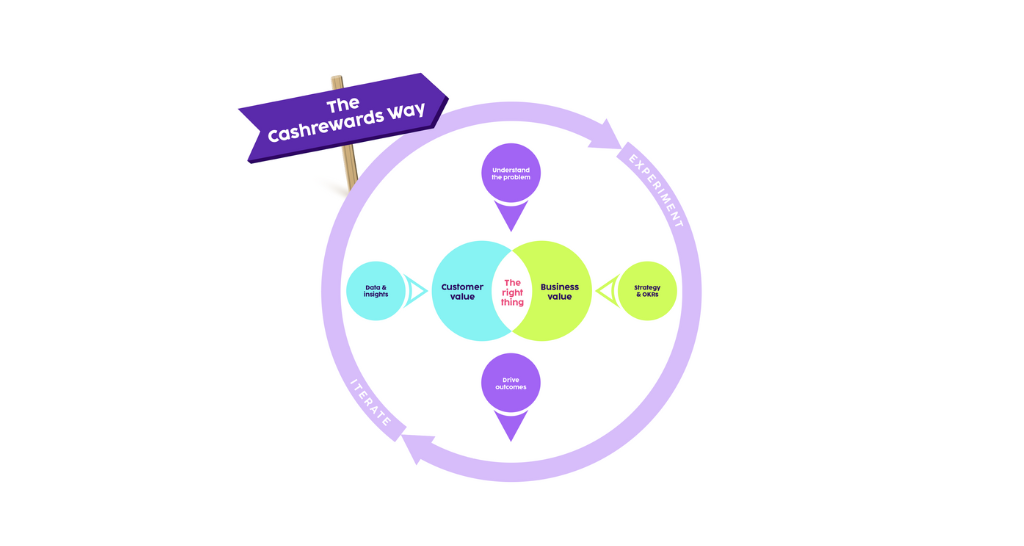
We started by redefining what it meant to be a product-led organisation but in The Cashrewards Way.
At its core, it was about balance: delivering value to members, merchants, and partners while driving business impact. To achieve that balance, we focused on a few guiding principles:
- Start with “why” — Who are we solving for? What problem are we solving? Why does it matter to the customer and the business?
- Comfort in ambiguity — Take the time to understand and validate the right problem before rushing to solutions.
- Collaboration over ownership — Align around common goals and outcomes, not team boundaries.
- Measure outcomes, not outputs — Success isn’t the number of features shipped; it’s the value created.
We worked closely with our Executive and Senior Leadership Teams to co-create a shared language and set of behaviours. This included introducing problem-framing tools, lightweight frameworks, and hands-on workshops to help teams think in outcomes rather than deliverables.
The Solution
The turning point came when we ran a company-wide initiative to socialise The Cashrewards Way.
Through a series of interactive workshops, we brought leaders from every function together to unpack what being product-led really looked like in practice.
We used frameworks like the Who, What, When, Why model and the Five Whys to help teams clarify their customer problems. Each group then applied these tools to real business challenges, reframing discussions away from “what should we build” to “what are we trying to solve.”
This shifted the tone of collaboration. Instead of product dictating direction, product became the facilitator of strategic thinking, helping teams connect business objectives to customer value.
The Impact
Over time, the cultural shift became visible:
- Teams began speaking a shared language around problems, outcomes, and value.
- Decisions started with customer insight and business context, not assumptions.
- Leaders across the organisation became confident in facilitating their own problem-framing sessions.
- Most importantly, “product-led” stopped meaning product-owned and started meaning customer- and outcome-led.
What I Learned
Looking back, this was one of the most meaningful transformations I’ve been part of.
I learned that being product-led isn’t about hierarchy or ownership, it’s about creating an organisation where everyone is empowered to think like a product person: curious about customer needs, focused on outcomes, and comfortable with iteration.
It’s about turning “that’s product’s job” into “that’s our shared responsibility.”
And when that shift happens, alignment, accountability, and innovation naturally follow.